Choosing the wrong pouch is not just about looks. It can slow down your production line, increase costs, and create unnecessary headaches.
Today, we’ll break it down in plain, practical terms: what’s the real difference between stand-up pouches and flat bottom pouches (also known as box pouches)? This guide will help you make the right call.
Quick Comparison Table: Key Differences at a Glance
1. What Are These Two Pouches, Really?
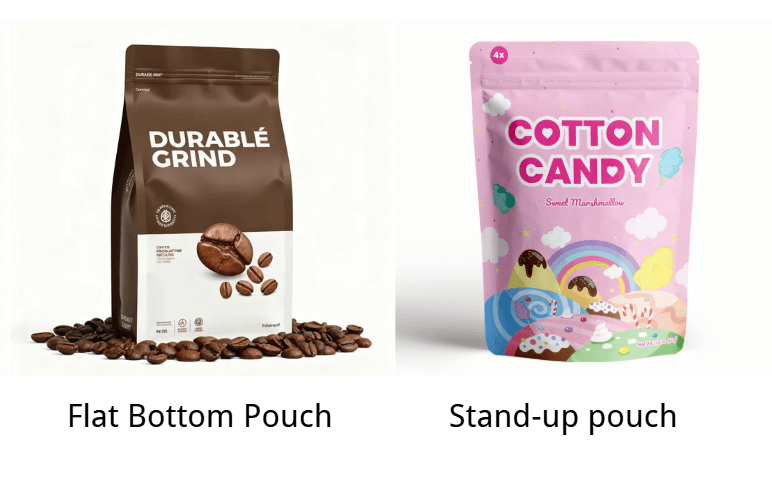
Stand-Up Pouches
Stand-up pouches are flexible packaging bags with a bottom gusset. Once filled, the gusset opens up, allowing the pouch to stand upright on shelves.
Because they are simple, versatile, and easy to run, stand-up pouches have become a go-to solution across many industries. They are the true workhorse of flexible packaging.
Flat Bottom Pouches
Think of a flat bottom pouch as a soft-material box. It has crisp edges, a solid flat base, and a very structured appearance.
When filled, it looks neat, premium, and well-defined. That’s why it is often used for high-end products that rely heavily on shelf presentation.
2. How Much Does the Structural Difference Affect Production?
The key difference lies in the bottom design.
The gusseted bottom of a stand-up pouch is flexible. If the fill weight is slightly higher or lower, the gusset naturally adjusts. This makes it far more forgiving during production.
The fixed flat bottom of a flat bottom pouch leaves little room for error. Underfilled pouches look collapsed and unstable. Overfilled pouches may stress the seals or fail to stand properly. In short, flat bottom pouches have much lower tolerance for filling variation.
3. Different Experiences in Forming and Filling
Pouch Forming and Sealing
Producing stand-up pouches is similar to sealing a regular envelope. The process is fast, straightforward, and easy to operate.
Flat bottom pouches are more like assembling a three-dimensional structure. Multiple panels must align perfectly, and every seal must be precise. This places higher demands on both packaging machines and operators.
Filling Process
Stand-up pouches are relatively stress-free during filling. Small dosing deviations usually do not affect the final appearance.
Flat bottom pouches require high-precision dosing systems to ensure every pouch looks uniform, upright, and premium on the shelf.
4. Can Your Existing Packaging Equipment Handle Both?
If you already operate a standard pouch packaging line, switching to stand-up pouches is usually smooth and cost-effective. Machine compatibility is high, and setup time is short.
If you plan to use flat bottom pouches, careful evaluation is essential. Can your current equipment handle this structure? Will you need machine upgrades or a dedicated solution? These factors directly impact your investment level and time to market.
5. Common Mistakes to Avoid
Many companies choose flat bottom pouches for their premium appearance without considering equipment capability. As a result, production efficiency drops or the project fails entirely.
Another common issue is ignoring filling accuracy. Using box pouches with rough or outdated dosing systems leads to poor stability and inconsistent appearance, which ultimately damages brand perception.
Skipping real-world testing is also a major risk. Regardless of pouch type, always test your actual product on your real production line before full-scale production.
6. How to Choose: A Clear Decision Guide
If you prioritize efficiency, flexibility, and cost control, stand-up pouches are the safer and more proven option. They are highly adaptable and widely used across industries.
If your focus is premium shelf appeal and a high-end brand image, and your product is valuable or relatively heavy, flat bottom pouches can be an excellent choice. The key condition is being ready to invest in precise equipment and tighter process control.
One-Stop Packaging Solutions You Can Rely On
Choosing the right pouch is only the first step. Matching it with stable and efficient packaging equipment is what truly makes mass production successful.
LTPM CHINA brings years of industry experience and offers far more than just machines.
We provide professional consultation based on your product type, whether powder, granules, liquids, or solids, and your chosen pouch style, including stand-up pouches, flat bottom pouches, and three-side seal bags.
Our packaging machines range from semi-automatic to fully automatic models, all designed for stability, reliability, and smooth operation.
For special requirements, we offer customized and modified production lines to ensure perfect compatibility between your pouch, product, and production speed.
From installation and commissioning to operator training and long-term technical support, we support you throughout the entire lifecycle.
Stop struggling with pouch selection and equipment matching. Contact us today to receive a tailored packaging solution that turns your packaging concept into stable, scalable market competitiveness.