This guide is written for maintenance engineers and plant technicians who need practical steps, not general theory. It focuses on the faults that appear most often on real VFFS lines, including film drift, unstable sealing, fill inconsistency, sensor alarms, and repeat downtime.
If a VFFS machine stops or starts producing poor bags, check film tracking, sealing temperature, filling synchronization, air supply, and sensors first.
In most cases, the fault is not the whole machine but one subsystem that has become dirty, misaligned, worn, or out of recipe.

Key Terms
- Dancer arm: a tension-control component that helps keep film feed stable.
- Encoder: a sensor that measures film movement and helps control bag length.
- Dwell time: how long the sealing jaws stay closed during the sealing cycle.
- Fin seal: a vertical seal where the film edges meet.
- Lap seal: a vertical seal where one film edge overlaps the other.
- Photoeye / sensor: a detection device used to confirm position, print mark, or machine status.
Common Faults at a Glance
1. Film Unwind & Tension Control
The film unwind system feeds film into the machine and keeps tension stable. If film tracking is unstable, the first place to inspect is the unwind section, including the spindle, dancer arm, roller condition, and edge guide sensor.
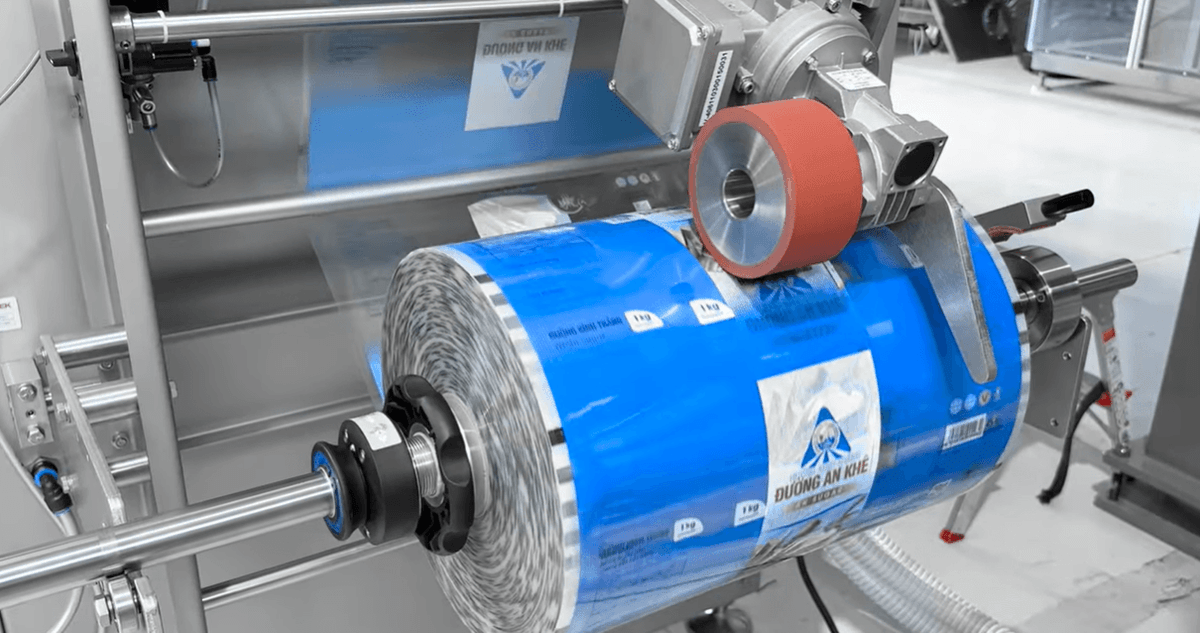
What usually goes wrong
- Film drifts to one side.
- Film wrinkles during feeding.
- Film tension becomes unstable.
- Pull belts slip or do not move smoothly.
A common case is film drifting right after a roll change. The cause is often the new roll being loaded slightly off-center. Before changing settings, confirm the roll position, film threading path, and belt condition.
2. Forming Collar & Fill Tube
The forming collar shapes flat film into a tube, and the fill tube guides product into the bag. If bag shape becomes uneven, inspect the forming section before changing sealing settings.

What usually goes wrong
- Wrinkled bags.
- Skewed bags.
- Gusset problems.
- Bag length variation caused by feed instability.
If wrinkles remain after tension is adjusted, the problem is often geometry rather than film. A forming collar that is slightly out of vertical can keep producing creases even when the roll and belts appear normal.
3. Vertical Sealing Unit
The vertical sealing unit creates the longitudinal back seal of the bag. This area is sensitive because poor temperature, pressure, or alignment can create a weak seal that fails later in handling or transport.

What usually goes wrong
- Weak or uneven vertical seal.
- Product residue in the seal area.
- Misalignment between film overlap and sealing band.
- Worn Teflon tape or seal surfaces.
Weak vertical seals can result from low temperature, defective heating cartridges, defective temperature probes, low air pressure, or misalignment of the sealing unit. That is why seal problems should be checked in order: temperature, pressure, alignment, then component wear.
4. Filling / Dosing System
The filling system controls how much product is dropped into each bag. If fill weight is unstable, the issue may be in the dosing equipment, the product flow, or synchronization with the machine cycle.

What usually goes wrong
- Inconsistent fill weight.
- Product spillage into the seal area.
- Slow or no product flow.
- Product bridging or blockage in the hopper.
For powder applications, many engineers verify the auger zero point at the start of the shift and run a small sample test before production. If the error is systematic rather than random, calibration drift is often the root cause.
5. Horizontal Sealing Jaws & Knife
The horizontal jaws create the top seal of the filled bag and the bottom seal of the next bag. The knife then separates the finished bag from the tube. Temperature, pressure, dwell time, and blade condition all affect the result.

What usually goes wrong
- Poor seal quality.
- Seal burn or scorching.
- Bags not separating cleanly.
- Film wrapping around the jaws.
The same machine may seal one film well but fail with another. In that case, the recipe is usually the problem, not the machine. Different materials need different combinations of temperature, pressure, and dwell time.
6. Control Panel & HMI
The HMI and control panel let operators monitor alarms, speed, temperature, and recipe settings. If the machine stops unexpectedly, check the alarm history before making mechanical changes.
What usually goes wrong
- Machine fails to power on.
- Error messages or sudden stops.
- Touchscreen freezes.
- Settings do not save.
If the machine stops but the mechanical parts still look normal, the cause may be a sensor or wiring issue rather than a major equipment failure. Engineers should read the HMI alarm code first and not skip the control layer.
If the issue keeps returning, send us your machine model, product type, and fault symptoms so we can help you identify the next step.
Daily & Preventive Maintenance Checklist
Routine maintenance keeps the same faults from returning again and again.
Daily tasks
- Clean film contact parts.
- Check tracking before production.
- Verify temperature and pressure.
- Inspect sensors and belts.
- Confirm alarms are clear before startup.
Weekly tasks
- Clean and calibrate sensors.
- Lubricate moving parts where required.
- Inspect sealing jaws and replace worn tape.
- Tighten fasteners and check alignment.
- Verify air pressure and electrical connections.
Monthly tasks
- Validate sensor calibration.
- Inspect bearings and moving assemblies.
- Test safety interlocks and emergency stops.
- Review production logs for recurring issues.
- Check alignment relative to the film path.
Upgrade vs Repair
If a machine keeps needing adjustment, or if parts are hard to source, the issue may not be a single fault. In older systems, recurring downtime can mean the machine itself has reached the point where repair costs are no longer efficient.
Signs it may be time to upgrade
- Repeated seal failures after calibration.
- Film tracking problems that keep returning.
- Filling accuracy that cannot be stabilized.
- Control parts that are no longer easy to replace.
- Maintenance time keeps increasing while output stays flat.
If several of these issues appear together, the better answer may be a machine upgrade rather than another repair cycle.
FAQ
1.What should I check first when a VFFS machine stops?
Start with the HMI alarm code, air supply, sensor status, and the most recent change in film, product, or recipe.
2.Why does my film keep drifting?
The most common causes are off-center rolls, dirty rollers, belt misalignment, or tension instability.
3.Why are my seals weak but not burned?
That usually points to low temperature, low pressure, dirty seal surfaces, or a recipe mismatch.
4.When should I replace a wear part instead of adjusting settings?
If the same symptom keeps coming back after cleaning, alignment, and calibration, inspect the wear part next.
Final Note
A VFFS machine is easiest to troubleshoot when you work from symptom to subsystem. Start with film tracking, seal quality, fill accuracy, and sensor alarms, then move into the relevant part only as far as needed.
The best engineers do not guess first. They check the simplest likely cause, confirm the fault path, and only then change settings or replace parts.
Need VFFS parts support or troubleshooting help? Send us your machine model, product type, and issue description, and we will help you identify the right part or the right next step.